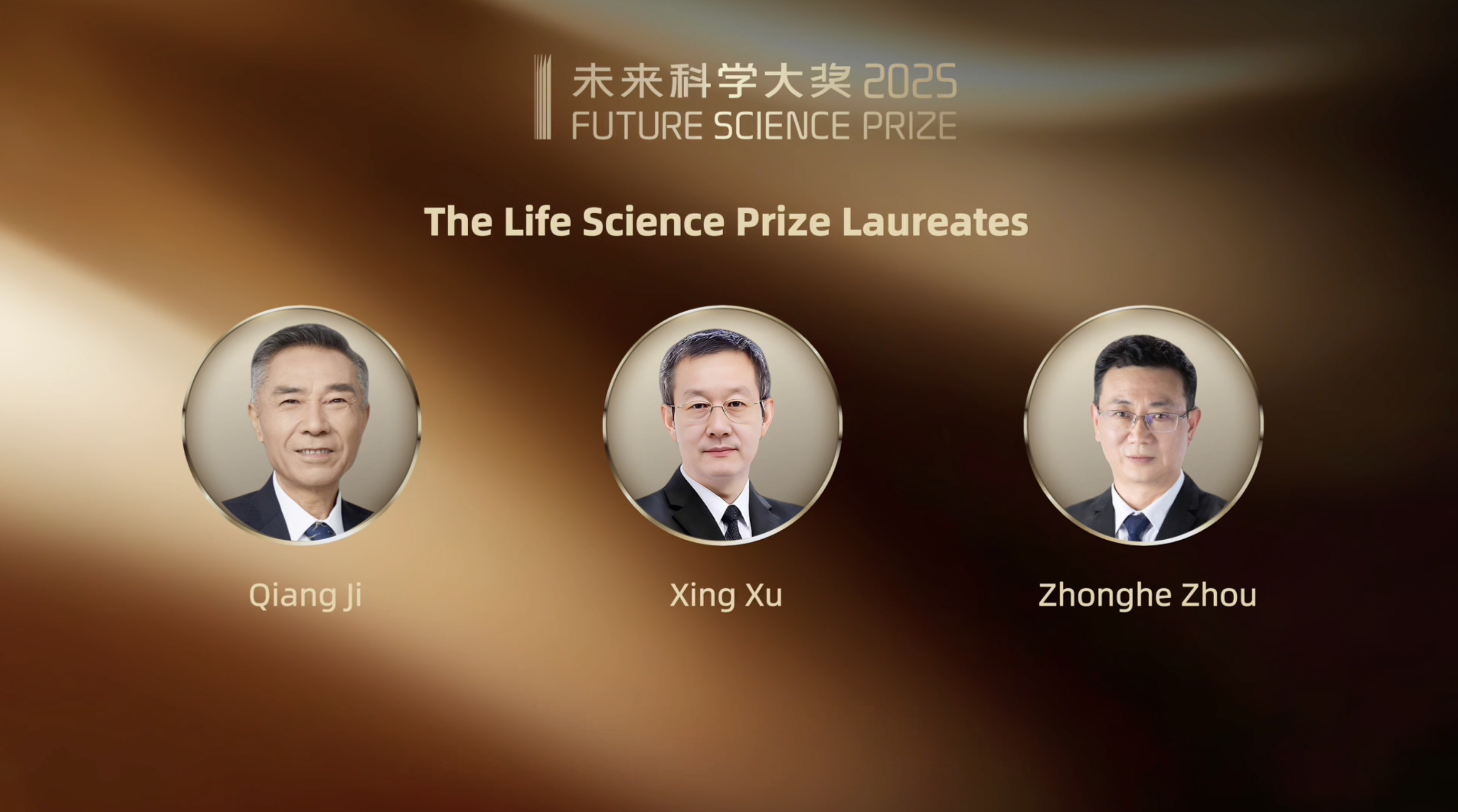

Distinguished guests, fellow scientists, and friends from all sectors, good evening!
Standing here in Hong Kong, a vibrant hub where Eastern and Western science and culture converge, as I accept the Future Science Prize, my heart is filled with immense gratitude and reverence. First and foremost, I would like to express my sincere thanks to the donors, the Scientific Committee, and the nominators of the Future Science Prize. You have built a beacon for science through private philanthropy. Your steadfast commitment to basic research and your profound foresight have illuminated the path of exploration for scientists worldwide.
This honor is hard-won and unequivocally belongs not to me alone. I must extend my deepest respect to my research team. It is our collective dedication over more than two decades, drawing strength from countless setbacks in practice, that has ultimately yielded the discoveries we see today. I am profoundly grateful to every collaborator for their trust and support. In an era of ever-deepening interdisciplinary research, it is precisely this kind of boundary-crossing collaboration that has allowed us to break through the limitations of any single field. I also wish to thank my family, especially my wife, Ms. Yang Li, for their long-standing understanding and companionship. It is your unwavering support that has allowed me to devote myself wholeheartedly to scientific inquiry and focus on those major scientific questions that require time and patience to unravel.
Reflecting on my scientific journey, from an initial curiosity about the mysteries of life to the perseverance required in the face of skepticism, every step has been facilitated by the opportunities afforded by our times. This great era has provided us with a conducive research environment, resources for scientific exploration, and the freedom to pursue it, enabling the convergence and cross-pollination of scientific intellect from across the globe. Our past research focused on the origin of birds, a puzzle that had remained unsolved internationally for over 140 years. My approach is rather straightforward: I have always adhered to a fact-based methodology. From the discovery and identification of feathered dinosaur fossils (such as Sinosauropteryx, Protarchaeopteryx, and Caudipteryx) to exploring why dinosaurs developed feathers; from confirming the transition of dinosaurs into warm-blooded endotherms to proposing the consolidation of dinosaurs and birds into a single class, the Dinosauria – each step represented a groundbreaking innovation, venturing from zero to one. Although the theory that birds originated from small carnivorous dinosaurs has become the mainstream academic view in the international scientific community, many still do not fully grasp its scientific implications, continuing to classify dinosaurs within the cold-blooded, ectothermic Reptilia. Prior to 1996, birds had a clear definition: in the animal kingdom, only birds possessed feathers. Thus, it was understandable to define the class Aves by the characteristic of feathers, distinguishing them from other animals. However, after 1996, with the discovery of a series of feathered dinosaurs in China, feathers are no longer a unique characteristic of birds. Modern birds are merely the descendants of small carnivorous dinosaurs, indicating that the class Aves has lost the definition and basis for being established as a separate class.
As early as the late Triassic period, 225 million years ago, cold-blooded, ectothermic reptiles diverged into two evolutionary lineages: one leading to mammals and eventually humans, and the other leading to dinosaurs and eventually birds. Both of these lineages are warm-blooded endotherms. If humans represent just one "family" within mammals, why should birds warrant the establishment of an entire "class"?
The conferment of the Future Science Prize is not only a recognition from the scientific community for our research achievements but also an inspiration and a mandate, encouraging us to continue pursuing more visionary and adventurous research. My team and I are currently investigating the evolutionary history of humans over the past one million years. We will take this Prize as a new starting point, striving to make progress and contributions in the field of paleoanthropology.
Finally, I would like to once again thank the Future Science Prize and all those who support the cause of science. The future holds great promise, and we will undoubtedly reap more surprises on our journey to unravel the mysteries of life.
Thank you all once again!